The Unmatched Interior: How Americans Learned to Stop Coordinating and Start Confessing

There was a time, not so distant, when walking into an American living room and finding a sofa, coffee table, and entertainment console drawn from the same showroom collection was considered not merely acceptable but aspirational. The coordinated suite—those carefully assembled groupings that furniture retailers once displayed under names like "The Stratford" or "The Berkshire"—communicated something beyond aesthetic preference. It communicated arrival. It said that the people who lived here understood how rooms were supposed to behave.
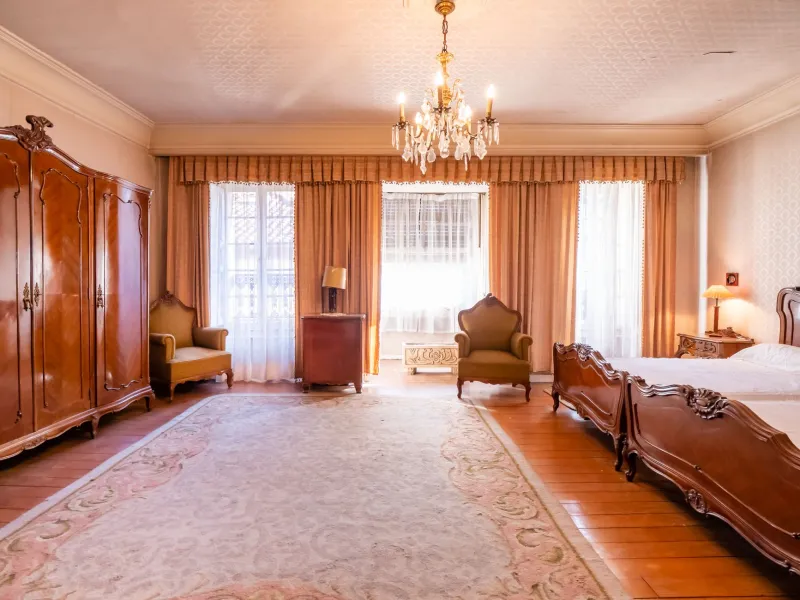
That understanding has quietly collapsed. In its place has emerged something far more complicated, and arguably far more honest: the eclectic interior, assembled from competing eras, opposing sensibilities, and thoroughly unrelated sources. Americans are no longer apologizing for the mid-century credenza sitting beside the farmhouse dining table, or the inherited wingback chair that refuses to harmonize with anything else in the room. They are, in many cases, celebrating these contradictions. And the history of how that happened is worth examining closely.
The Reign of the Coordinated Room
To appreciate the magnitude of the shift, one must first understand how thoroughly the coordinated interior dominated American domestic culture across much of the twentieth century. Department stores and dedicated furniture retailers built entire business models around the concept of the matching set. Sears catalogs from the postwar decades offered living room "groups" and bedroom "suites" as self-contained solutions—units of respectability that could be acquired in a single transaction and arranged according to a diagram.
The appeal was not merely aesthetic. In a period of rapid suburban expansion, when millions of American families were furnishing newly built homes for the first time, the coordinated room offered reassurance. It removed the anxiety of choice. Design decisions had been made by professionals; the consumer's role was simply to select a wood finish and a fabric swatch. The result was interiors that were coherent, legible, and largely interchangeable—which suited a cultural moment that prized conformity as a form of social stability.
Design publications of the era reinforced these expectations. Shelter magazines presented rooms in which every element appeared to have arrived together, curated by an invisible hand with impeccable judgment. Deviation from this model—an heirloom piece that didn't belong, a lamp purchased at a discount—was treated as evidence of either poverty or poor taste, and the distinction between the two was rarely made with much generosity.
The Economics of Incompatibility
The first serious disruption to the coordinated interior came not from aesthetics but from economics. The rise of IKEA's American presence in the 1980s and 1990s introduced a generation of young consumers to furniture that was affordable, modular, and deliberately neutral—pieces designed to be combined rather than matched. The flat-pack aesthetic didn't demand loyalty to a single collection. It invited improvisation.
Simultaneously, the American thrift store and flea market circuit was undergoing its own transformation. What had once been a destination of financial necessity was reframed, gradually, as a destination of cultural discovery. Vintage shops proliferated in urban neighborhoods. Estate sales became weekend rituals for a certain class of design-aware consumer. The language around secondhand furniture shifted from "used" to "found"—a single word doing considerable ideological work.
By the early 2000s, a room assembled from multiple eras and multiple sources was no longer automatically read as the product of limited means. It could, under the right conditions, be read as the product of a discerning eye. The precondition, of course, was that the eclecticism appear intentional. And that distinction—between accidental mismatch and deliberate curation—would become the central tension of American interior design discourse for the following two decades.
Social Media and the Permission Structure
No account of this cultural shift is complete without acknowledging the role of social media, and specifically the visual platforms that turned the private interior into a form of public self-expression. Instagram, Pinterest, and later TikTok did not merely document the eclectic interior—they legitimized it at scale, and with extraordinary speed.
When a room assembled from thrift-store finds, inherited pieces, and budget furniture could accumulate hundreds of thousands of approving responses, it sent a signal that the old arbiters of domestic taste—the shelter magazine editors, the department store display designers—no longer held exclusive authority. Taste was being democratized, and the eclectic interior was its most visible symbol.
What social media provided, more than anything, was a permission structure. It told ordinary Americans that their grandmother's lamp and their college-era bookshelf and their recent vintage market acquisition could coexist in the same room without apology. It offered evidence, in the form of enthusiastic engagement, that authenticity was valued more highly than coherence. The confession embedded in the mismatched room—I live here; this is actually who I am—turned out to be precisely what audiences wanted to see.
Generational Values and the Rejection of the Showroom
Millennial and Generation Z consumers have approached the furnished interior with a set of values that differ meaningfully from those of their predecessors. Sustainability concerns have made the purchase of new, coordinated furniture sets feel not merely unnecessary but ethically questionable to a significant portion of these cohorts. The secondhand piece is not a compromise; it is, in many cases, a preference.
Equally significant is a generational skepticism toward the curated perfection that characterized earlier domestic ideals. The rooms that circulated in mid-century shelter magazines—spotless, symmetrical, inhabited by no one in particular—register to many younger Americans as sterile rather than aspirational. The eclectic interior, with its visible history and its refusal to resolve into a single aesthetic statement, feels more truthful. It acknowledges that a life is not a single chapter.
There is also, it must be said, a reaction against the specific aesthetic that dominated design media in the early 2010s: the grey-and-white, shiplap-and-subway-tile uniformity that spread from certain television programs across millions of American homes with remarkable efficiency. That aesthetic was coordinated in the extreme—a new kind of matching suite, drawn not from a furniture showroom but from a renovation television format. The backlash, when it arrived, expressed itself in color, texture, and deliberate incongruity.
What the Mismatch Confesses
The most interesting dimension of this shift is what it reveals about American identity at a particular moment. The coordinated interior was, at its core, a form of self-erasure—a declaration that one's personal history and individual preference had been successfully subordinated to a shared standard of taste. The eclectic interior is the opposite: it insists on visibility. Every inherited piece, every found object, every deliberately odd combination says something about the person who assembled it.
This is, in the language of design history, a move from the prescriptive to the autobiographical. The room is no longer a performance of belonging to a social category. It is a record of a particular life, with all the inconsistency that implies. The furniture confession, as one might call it, is less about aesthetic rebellion than about a changed relationship between the private self and the domestic space it inhabits.
Whether this shift represents a permanent reorientation of American interior culture or a corrective pendulum swing remains to be seen. Design history suggests that no aesthetic remains ascendant indefinitely, and the eclectic interior will eventually acquire its own orthodoxies and its own counterreactions. But for now, the unmatched room stands as one of the more candid portraits the American home has offered of itself in some time—and that, at minimum, is worth preserving in the record.