Ordered by Desire: The American Closet as a Portrait of the Self
There is perhaps no domestic space more honest than the closet. Unlike the living room, which performs for guests, or the kitchen, which negotiates between function and aesthetics, the closet answers to no audience but its owner. It is, in this sense, one of the last genuinely private interiors in the American home—and yet, paradoxically, it has become one of the most publicly discussed. To trace the history of the American closet is to trace the history of what Americans have chosen to keep, how they have chosen to keep it, and what they believe those choices say about who they are.
A Room That Was Never Meant to Be a Room
In the earliest American domestic architecture, the closet occupied a humble and largely overlooked position. Colonial-era homes rarely included dedicated storage spaces at all; goods were stored in trunks, on open shelving, or in the cellar. When closets did appear in eighteenth- and nineteenth-century houses, they were shallow, often poorly lit, and entirely subordinate to the rooms they served. The word itself derived from the French cabinet, denoting a small private chamber—a space for withdrawal and quiet thought—but in the American context, the closet quickly shed any philosophical pretension and became simply a place to put things out of sight.
Throughout the Victorian era, the closet remained a secondary architectural consideration. Homes of the period prioritized the display of objects in public rooms—the parlor's curio cabinet, the dining room's sideboard laden with silver—while the closet absorbed what could not be shown. Clothing, linens, seasonal items, and household surplus disappeared behind closed doors, and the closet's interior was of no particular concern to anyone beyond the servants tasked with its management.
This arrangement began to shift meaningfully in the early twentieth century, as domestic service declined and the American middle class assumed direct responsibility for the organization of their own households. Suddenly, the closet was no longer managed by someone else. It was a problem to be solved by its owner.
The Postwar Expansion and the Promise of Order
The postwar housing boom of the 1940s and 1950s introduced the reach-in closet as a standard feature of the American suburban home. Builders recognized that storage was a selling point, and bedroom closets—typically a single rod flanked by a shelf above—became a reliable amenity to advertise. But the space remained largely undifferentiated: a rod, a shelf, a bare bulb. The assumption was that clothing would be hung and order would follow naturally.
It did not. As American consumer culture expanded dramatically in the postwar decades, closets became repositories of accumulation rather than organization. The clothing rod sagged under the weight of garments purchased across multiple seasons and shifting tastes. The shelf above became a graveyard for hat boxes, spare blankets, and objects without a better home. The closet, in short, became a mirror of postwar abundance—and of the anxieties that accompanied it.
Design culture began to respond in the 1970s and 1980s, when the first wave of closet organization systems emerged as a consumer product category. Companies such as California Closets, founded in 1978, introduced the idea that the closet's interior could be designed—that adjustable shelving, divided compartments, and specialized storage solutions could transform a chaotic alcove into a legible, functional system. The closet, for the first time, became a designed space rather than simply an enclosed one.
The Walk-In and the Theater of Possession
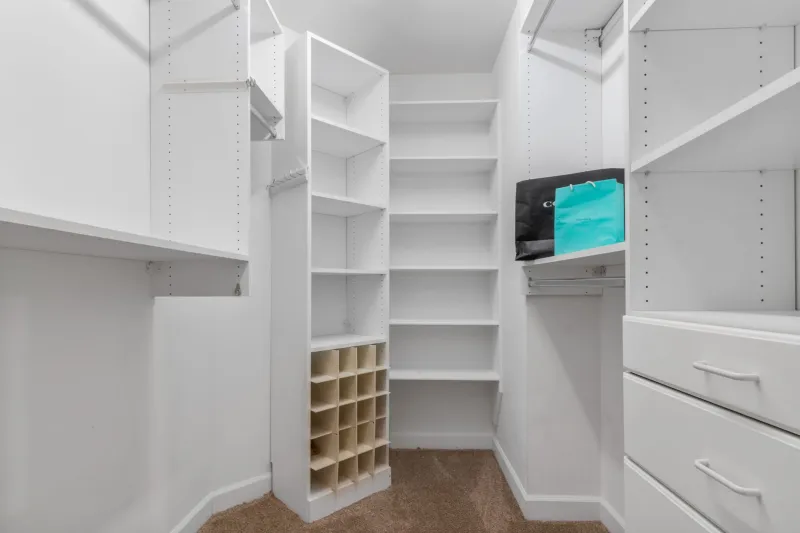
No development in closet history carries more cultural weight than the rise of the walk-in closet. By the 1980s and 1990s, the walk-in had become a standard aspiration in American luxury home design, appearing prominently in the master suites of upscale subdivisions and in the design magazines that documented them. Its appeal was not purely functional. A walk-in closet is, at its core, a room devoted entirely to the self—to one's clothing, accessories, and personal possessions. It is a space that declares, through its very existence, that the inhabitant has enough belongings to warrant a dedicated interior.
The cultural moment that cemented the walk-in closet's status as a symbol of aspiration arrived, perhaps inevitably, through television. The closet scene in the 1995 film Clueless, in which Cher Horowitz navigates a computerized wardrobe system, offered a vision of closet-as-fantasy that resonated far beyond its satirical intent. Later, the walk-in closet belonging to Carrie Bradshaw in Sex and the City became arguably the most discussed domestic interior in American popular culture at the turn of the millennium—a space in which shoes were displayed like sculpture and clothing was archived like art. These representations did not merely reflect existing aspirations; they actively shaped them.
Luxury Systems and the Closet as Investment
By the early 2000s, the American closet had entered the economy of home renovation in earnest. Custom closet systems—offered by an expanding industry of designers, retailers, and specialized contractors—presented the closet not as a maintenance cost but as an investment, both financial and personal. Materials escalated accordingly: laminate gave way to solid wood, wire shelving to velvet-lined drawers, fluorescent tubes to LED strip lighting calibrated to flatter the colors of hanging garments. The closet had acquired the vocabulary of interior design.
This transformation was accompanied by a corresponding shift in how Americans spoke about their closets. Organization became a subject of genuine cultural discourse. Books on decluttering—most famously Marie Kondo's The Life-Changing Magic of Tidying Up, which achieved remarkable circulation in the United States following its 2014 translation—framed the act of sorting one's possessions as a form of self-knowledge. To curate a closet was to curate an identity. What one kept, and how one kept it, became legible as a statement of values.
The Social Media Closet and the Collapse of Privacy
The final and most consequential chapter in the closet's cultural evolution arrived with the smartphone and the social media platform. What had historically been the most private interior in the American home became, for a significant segment of the population, a public one. The "closet tour" emerged as a recognizable genre of online content, with influencers and celebrities inviting millions of viewers into spaces that had once been the exclusive province of their occupants. Platforms such as Instagram and TikTok transformed the organized closet into a performance—a demonstration of taste, discipline, and material achievement.
This inversion is historically remarkable. The closet, which derived its cultural function precisely from its capacity to conceal, had become a vehicle for disclosure. The objects once hidden from view were now the objects most deliberately displayed. And in that reversal, the closet revealed something fundamental about the broader American relationship between private identity and public persona: the boundary between the two had not merely blurred; in many instances, it had ceased to exist entirely.
What the Closet Holds
To walk through the history of the American closet is to walk through a history of aspiration, anxiety, accumulation, and ultimately self-definition. What began as an architectural afterthought—a shallow recess in which to deposit the overflow of daily life—has become one of the most charged and revealing spaces in the domestic landscape. It is a space that holds not merely clothing and objects, but evidence of who its owner believes themselves to be, and who they hope others will recognize them as.
The museum of American interiors, if it were to identify a single room that most faithfully documents the nation's evolving relationship with identity and consumption, might well find its answer behind a closed door.