From Placement to Composition: The American Interior's Transformation into a Curated Space

There is a particular kind of paralysis that descends upon the modern American homeowner standing in an empty room. It is not the paralysis of indecision about where to place the sofa for optimal television viewing, nor is it the practical calculus of traffic flow and doorway clearance. It is something altogether more ambitious — and, in its way, more revealing. It is the paralysis of the curator, confronting a blank gallery wall and asking not merely what fits, but what means.
This transformation in domestic thinking — from furniture arrangement as a logistical exercise to furniture placement as an act of authorship — did not happen overnight. It accumulated across decades, propelled by shifting cultural forces, new technologies of image distribution, and a profound reimagining of what the American home is fundamentally for.
The Utilitarian Baseline
For the greater part of the twentieth century, the arrangement of domestic furniture followed a largely unspoken grammar. Sofas faced televisions. Dining tables occupied dining rooms. Beds were pushed against walls to maximize floor space. These decisions were governed by function, by the dimensions of inherited pieces, and by the practical demands of households in motion — families eating, children playing, adults resting after labor.
Design publications existed, naturally, and department store room displays offered aspirational tableaux to the middle-class shopper. But the distance between those idealized arrangements and the lived reality of most American interiors was vast and largely accepted. The home was understood as a place of use, not a place of display. Furniture served the people inside it; it did not perform for an audience beyond them.
Even the emergence of dedicated shelter magazines in the mid-twentieth century — House Beautiful, Better Homes and Gardens, Architectural Digest — operated within a framework of aspiration that remained, for most readers, comfortably theoretical. One admired the photographs and returned to one's own rooms with perhaps a new appreciation for slipcovers, but without any fundamental revision of the relationship between occupant and object.
The Arrival of the Audience
What changed, with consequences that continue to unfold, was the introduction of a perpetual, participatory audience. The rise of home design content on platforms such as Pinterest in the early 2010s, followed by the visual grammar of Instagram and, later, the domestic theater of TikTok, did not simply give Americans new sources of decorating inspiration. It gave them something more structurally significant: the knowledge that their interiors could be seen.
This is not a trivial shift. The awareness of an audience — even a potential, hypothetical one — fundamentally alters the nature of domestic decision-making. A sofa placed for comfort alone is a private object. A sofa placed with an understanding of how it will appear in a photograph, how its profile will read against a gallery wall, how its color will anchor a composition — that is something closer to a prop in a production one has chosen to stage.
Design influencers accelerated this transition by translating the vocabulary of professional interior design into the vernacular of everyday homeownership. Concepts such as visual weight, negative space, the layering of textures, and the strategic deployment of a single statement piece migrated from the design studio into the domestic imagination of millions of Americans who had never hired a decorator and had no intention of doing so. The language of curation — previously reserved for museums and galleries — entered the living room.
The Statement Piece and Its Discontents
Perhaps no single phenomenon illustrates the shift more precisely than the rise of the statement piece as a category of domestic object. The statement piece — a chair of unusual form, a light fixture of theatrical scale, a rug of aggressive pattern — is defined not by its function but by its rhetorical purpose. It exists to announce something: a sensibility, a willingness to take risks, an acquaintance with design history.
In a purely utilitarian interior, the statement piece has no logical home. In a curated one, it is often the organizing principle around which everything else is arranged. Americans began shopping not for furniture that would complete a room but for objects that would define it — a reversal of priority that reshaped retail, manufacturing, and the design industry simultaneously.
Retailers responded. The emergence of companies such as Restoration Hardware, with its emphasis on architectural scale and gallery-like showroom environments, and the subsequent proliferation of boutique online furniture brands offering limited-edition pieces and "drop" models borrowed from streetwear culture, reflected a market that had come to understand furniture acquisition as a form of collecting. The object's history, provenance, and cultural legibility became selling points alongside its dimensions and durability.
Spatial Composition as Personal Narrative
What the curated interior ultimately represents is a claim about interiority — the interior life of the person who assembled it. The arrangement of objects in space has become a form of autobiography, a medium through which Americans communicate values, experiences, and aspirations that might otherwise remain unspoken.
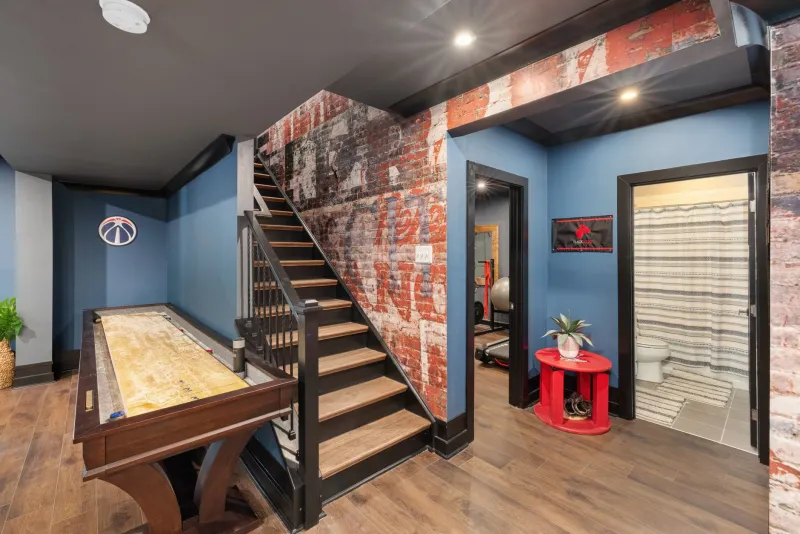
The deliberate inclusion of a vintage industrial piece in an otherwise contemporary room signals an appreciation for craft and history. The choice to leave significant open floor space in a culture that once equated fullness with prosperity signals a different kind of confidence — an aesthetic restraint that has its own social legibility. Even the decision to arrange books by color rather than by author or subject, a practice that would have struck an earlier generation as absurd, communicates something precise about the relationship between the owner and the objects they possess.
This is not to suggest that the curated interior is universally sincere. Design historians and cultural critics have noted the degree to which social media curation has produced its own orthodoxies — the linen-toned neutrals, the terracotta accent, the dried pampas grass — that can feel less like genuine self-expression than participation in a shared visual dialect. The curated interior, like all aesthetic movements, carries within it the seeds of its own conventionality.
The Museum in the Home
There is something instructive in the metaphor that has quietly colonized the language of domestic design: the home as museum. Americans now speak of "curating" their spaces, of placing objects in "conversation" with one another, of achieving the right "balance" between competing visual elements. These are the words of the exhibition designer, the gallery curator, the keeper of collections.
In borrowing this vocabulary, the American homeowner has implicitly claimed something significant — that the domestic interior is a space worthy of the same deliberate attention, the same respect for composition and meaning, that one brings to a public institution dedicated to the preservation of culture. The objects arranged in one's living room are, by this logic, artifacts. The room itself is an argument about what matters.
Whether this elevation of domestic space represents a genuine democratization of design culture or a symptom of an age in which private life has become inescapably performative is a question that admits no easy answer. What is certain is that the American interior has been permanently transformed by it. The room that was once arranged is now composed. The furniture that was once placed is now positioned. And the home, for better or worse, has become a kind of exhibition — one that its occupants curate, tend, and revise with the ongoing attention of those who understand that the space they inhabit is also, in some essential way, the story they are telling about themselves.