Beneath the Surface: The Remarkable Cultural Journey of the American Basement from Dread to Desire
There is a peculiar grammar to the American house—a hierarchy of rooms that communicates, without a single word spoken, what a family values, what it fears, and what it wishes to project to the world. For most of the twentieth century, the basement occupied the lowest rung of that hierarchy in every sense imaginable. It was the room where things were sent to be forgotten: broken appliances, holiday decorations, the slow accumulation of objects that had outlived their welcome in the living world above. To descend those stairs was, for many Americans, a minor act of courage.
That the same space now routinely appears in real estate listings as a premium selling point—finished, climate-controlled, outfitted with home theaters and wet bars and dedicated yoga studios—represents one of the more remarkable transformations in the long history of American domestic culture.
The Cellar and Its Discontents
The basement's earliest American incarnations were purely utilitarian. Colonial root cellars and later Victorian-era stone foundations served as temperature-regulated storage for perishables, coal, and the mechanical infrastructure of the household. There was no pretense of habitability. These were functional voids beneath the dignified rooms above, and they were treated accordingly.
The psychological weight attached to subterranean domestic space, however, ran considerably deeper than mere utility. Folklore, literature, and the popular imagination had long associated underground spaces with concealment, danger, and the uncanny. American households absorbed these cultural anxieties readily. The basement was where the furnace groaned and pipes knocked; where darkness gathered at the base of a narrow staircase; where children dared one another to descend and retrieve something from the shelves. Fear, in this context, was not incidental to the space—it was constitutive of it.
Wartime and the Architecture of Anxiety
The mid-twentieth century gave American households new and considerably more concrete reasons to think about what lay beneath them. During the Second World War and the subsequent Cold War decades, civil defense literature encouraged homeowners to consider their basements as potential shelters. Federal pamphlets, widely distributed through the 1950s and into the 1960s, offered guidance on reinforcing basement walls, stockpiling canned goods, and positioning families below ground in the event of nuclear attack.
The effect was paradoxical. On one hand, this official attention elevated the basement's strategic significance within the domestic imagination. On the other, it deepened the space's association with catastrophe and dread. To prepare a basement shelter was to acknowledge, in the most intimate domestic terms, that the world above might become uninhabitable. The room that already carried the weight of cultural unease now carried the weight of existential threat as well.
Yet something else was happening simultaneously. Postwar prosperity, suburban expansion, and the emergence of a robust middle-class leisure culture were beginning to reframe the basement's possibilities. The same square footage that might shelter a family from fallout could, in sunnier moments, shelter a ping-pong table.
The Recreation Room and the Promise of Informality
By the late 1950s and through the 1960s, the finished basement had acquired a new identity: the rec room. This was a space defined by its contrast with the formal rooms above—paneled in knotty pine, carpeted in indoor-outdoor material, furnished with cast-off sofas and folding tables. It was, crucially, a room where children could be loud, where adults could be casual, where the social performances demanded by the living room could be temporarily suspended.
The rec room represented an important shift in the cultural meaning of the basement. It acknowledged, for the first time in mainstream American domestic life, that the underground space could be inhabited rather than merely endured. It could host activity, sociality, and even pleasure. The bar cart appeared. The billiard table followed. In homes across the postwar suburbs—from the split-levels of Levittown to the ranch houses of Southern California—the basement became a second living room, governed by different rules.
This informality was itself significant. The rec room implicitly acknowledged that American family life required spaces unconstrained by propriety. The formal parlor demanded comportment; the rec room demanded only presence. In this sense, the finished basement of the mid-century was not merely a design trend but a social accommodation—a room built for the version of family life that actually existed, rather than the version that was performed for guests.
Adolescence and the Subterranean Bedroom
The basement's evolution continued in the 1970s and 1980s, when it became increasingly associated with the particular spatial needs of American adolescence. As families grew larger and houses remained fixed in size, the finished basement offered something invaluable: distance. Teenagers retreated downstairs with their stereos, their friends, and their desire for autonomy. Parents, for their part, were frequently relieved by the arrangement.
This period produced the cultural archetype of the basement bedroom—a space simultaneously within the home and apart from it, offering the illusion of independence within the structure of family life. The phenomenon was sufficiently widespread to generate its own iconography in American film and television, where the basement bedroom became shorthand for a particular kind of adolescent interiority: creative, slightly chaotic, emphatically personal.
The design implications were telling. Basement bedrooms of this era were rarely designed by anyone. They accumulated character through use—through band posters and string lights and the slow layering of objects that mattered to their occupants. They were, in their way, among the most authentic domestic spaces in the American house precisely because they escaped the decorative ambitions of the rooms above.
The Luxury Descent
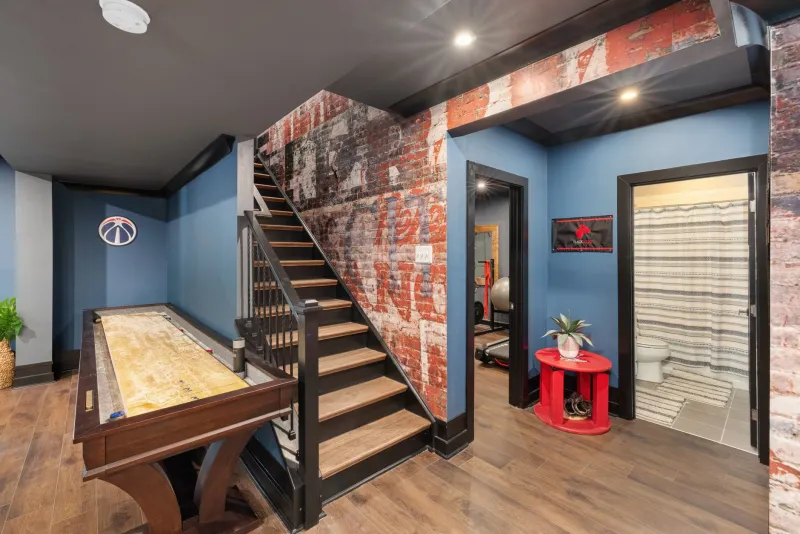
The twenty-first century has produced something the mid-century rec room could scarcely have anticipated: the basement as a primary site of domestic aspiration. In major American metropolitan markets—Chicago, Washington, D.C., New York, Seattle—finished basements command significant premiums in real estate transactions. The language used to describe them has shifted accordingly. Where once a listing might have noted "partially finished basement with storage," contemporary listings announce "lower-level entertainment suite" or "garden-level primary suite."
The amenities that now populate these spaces reflect the full breadth of contemporary American leisure and wellness culture. Home theaters with acoustic paneling and tiered seating. Wine cellars with climate control calibrated to the degree. Home gyms equipped with equipment that would not look out of place in a commercial facility. Recording studios, pottery rooms, libraries, and—particularly since the early 2020s accelerated the demand for dedicated work-from-home environments—offices of considerable sophistication.
What unites these varied programs is a shared aspiration toward completeness. The finished basement of the contemporary American home is no longer a supplementary space but a parallel one—a second household, in effect, capable of sustaining virtually any activity the floors above might offer.
The Psychology of Descent
It is worth pausing to consider what this transformation reveals about American domestic psychology. The basement's historical association with fear and concealment has not entirely disappeared; it has been sublimated, redirected, and in some cases deliberately engaged. The home theater, after all, is a space of controlled darkness—a room where the absence of natural light is not a deficiency but a feature. The basement gym capitalizes on the same sense of enclosure that once generated unease, reframing it as focus and intensity.
There is also the matter of privacy. In an era of open floor plans, shared domestic spaces, and the relentless visibility of life conducted across digital platforms, the basement offers something increasingly rare: genuine seclusion. To descend those stairs is to withdraw, deliberately and completely, from the household's social field. The room that once inspired dread now offers relief.
The Museum of Interiors recognizes in this trajectory a pattern familiar from other chapters of American design history: the spaces we once feared or ignored have a tendency, given sufficient time and cultural pressure, to become the spaces we most desire. The basement is simply the latest—and perhaps the most dramatic—example of that enduring principle.