The Threshold Reimagined: America's Entryway and the Architecture of First Impressions
There is a particular irony embedded in the history of the American entryway. For much of the twentieth century, the space charged with making the first impression was also the space least likely to receive any deliberate attention. It was a corridor, a coat-hook, a place where umbrellas went to be forgotten. Today, that same passage—whether a narrow urban foyer, a suburban mudroom, or a grand entry gallery—has become one of the most consciously designed areas in the American home. The question worth asking is not merely how this happened, but what the shift reveals about the culture that produced it.
A Brief History of the American Threshold
The concept of a dedicated entry space is, architecturally speaking, quite old. Colonial American homes often featured a central hall that served both circulatory and social functions—a room through which guests passed and, in more prosperous households, where status was first communicated through furnishings, portraits, and the quality of woodwork. As the nineteenth century advanced and Victorian domestic ideology took hold, the hallway became increasingly ceremonial. Umbrella stands, hall trees, and calling-card receivers occupied these spaces with a kind of theatrical precision.
The twentieth century, however, dismantled much of this formality. The post-World War II housing boom prioritized efficiency and square footage in living areas over ceremonial transitions. The ranch house, the split-level, and the modest Cape Cod frequently dispensed with a proper entry altogether. You stepped through the front door and arrived, almost immediately, in the living room. The threshold as a distinct architectural moment was largely erased from the middle-class floor plan.
For several decades, this arrangement went largely unexamined. The entryway, where it existed at all, was treated as negative space—a functional necessity rather than a design opportunity.
The Forces That Changed Everything
The rehabilitation of the entryway did not emerge from a single source. It was, instead, the product of several converging cultural pressures that gathered force through the late 1990s and accelerated dramatically in the 2010s.
The rise of visual social media—particularly Pinterest, which launched in 2010, and Instagram shortly thereafter—fundamentally altered how Americans understood the domestic interior. Spaces that had previously existed only for their inhabitants were suddenly being photographed, shared, and evaluated by audiences of strangers. Within this new visual economy, the entryway occupied a uniquely powerful position. It was the frame through which the rest of the home was introduced. A well-composed entry photograph communicated taste, intention, and identity before a single living room cushion came into view.
Simultaneously, the broader home renovation industry experienced a sustained boom. Television programming devoted to interior transformation—from HGTV's expanding catalog to the influence of design-forward streaming content—trained American audiences to see every room as improvable, every corner as a potential statement. The entryway, previously immune to such aspirations, was suddenly subject to the same scrutiny as the kitchen or the primary bathroom.
There was also a psychological dimension to this shift that design historians have begun to take seriously. The period following the 2008 financial crisis produced a renewed investment in the home as a site of emotional meaning. As economic uncertainty made the outside world feel less controllable, Americans turned inward—sometimes quite literally—and began to treat domestic spaces as extensions of personal identity and emotional refuge. The entryway, positioned precisely at the boundary between the public and the private, became a charged symbolic location.
What the Modern Entryway Communicates
To walk through a thoughtfully designed contemporary American entryway is to receive a great deal of information in a very compressed space. This is, in part, by design. Interior professionals who work on entry spaces frequently describe the goal in terms of narrative compression—establishing the aesthetic vocabulary of the entire home within the first few square feet.
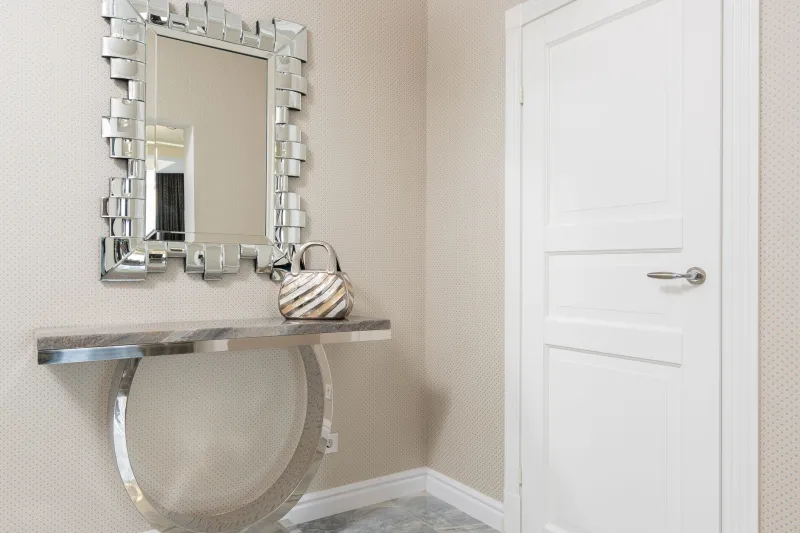
Consider the elements that now commonly populate these spaces: a carefully chosen console table, often antique or artisanal; a mirror selected as much for its frame as for its reflective function; a ceramic vessel or sculptural object that signals cultural familiarity with contemporary craft; a deliberate arrangement of hooks or a built-in bench that performs the practical work of the old hall tree while presenting itself as something more considered. Wallpaper has returned with particular force to the American entry, often in patterns bolder than anything found deeper in the house—a recognition that the entry is a room one passes through rather than inhabits, and therefore a space where visual intensity is permissible.
The mudroom, that more utilitarian cousin of the formal foyer, has undergone its own parallel elevation. Once a purely functional appendage—a place to shed muddy boots before entering the main house—it is now designed with the same attention given to more prominent spaces. Custom built-ins, curated baskets, chalkboard walls for family organization, and even decorative tile have migrated into what was once considered purely back-of-house territory.
The Performative Domestic Space
There is an argument to be made that the contemporary entryway represents one of the purest expressions of what sociologist Erving Goffman might have called "front stage" behavior applied to domestic architecture. It is the room designed most explicitly for an audience—for the guest who arrives, for the neighbor who glimpses the interior through an open door, and, increasingly, for the camera.
This performative quality does not necessarily render the entryway less sincere as a design expression. Rather, it places it within a long tradition of domestic spaces that have served simultaneously private and public functions. The Victorian parlor, the mid-century living room arranged around a television set, the open-plan kitchen of the 1990s—each of these was, in its moment, a space shaped partly by what it communicated to those who witnessed it.
What distinguishes the contemporary entryway is the degree of self-awareness that now accompanies its design. American homeowners today speak openly about what they want their entry to say—about warmth, about sophistication, about family, about a particular relationship to history or to craft. This articulate intentionality is itself a cultural development worth noting.
The Entry as Introduction
Museums understand, perhaps better than any other institution, the significance of the threshold. The transition from exterior to interior—from the street to the gallery—is carefully managed, because what happens in those first moments shapes everything that follows. The American home has arrived, somewhat belatedly, at a similar understanding.
The entryway is no longer a passage to be hurried through. It is, increasingly, the first room—the room that sets the terms for all subsequent rooms, that introduces the inhabitant before a word is spoken, that performs the considerable work of transforming a house into a home. That such a small space has come to carry such significant weight is a testament both to the ingenuity of contemporary design culture and to the enduring human need to mark, with some ceremony, the passage from one world into another.