Between Outside and In: The Quiet Rise of the American Mudroom as Considered Space

There is a particular kind of room that reveals more about a culture's priorities than any formal parlor or curated living space ever could. It is not the room designed to be seen, but the room designed to be used — the room that absorbs the mess, the weather, and the daily friction of American life before any of it reaches the interior proper. The mudroom, for most of this country's domestic history, was that room: invisible, unglamorous, and entirely beneath the notice of architects who reserved their ambitions for more presentable spaces.
That era of neglect has ended. The mudroom now occupies a position of genuine design significance in contemporary American homes, appearing in architecture magazines, commanding square footage once unthinkable, and serving as a canvas for the same considered material and spatial choices previously reserved for kitchens and primary bathrooms. Understanding how this transformation occurred requires looking not only at the room itself, but at the broader cultural shifts that made its reinvention both possible and necessary.
Origins in Obscurity
The functional antecedents of the mudroom are as old as American domestic architecture itself. Early farmhouses and rural dwellings across New England and the Midwest frequently incorporated small back entries or service passages — spaces that buffered the working exterior from the inhabited interior. These were not designed spaces in any meaningful sense. They were practical concessions to climate and labor: places where field-worn boots could be removed, where muddy overalls might be hung, where the transition between outdoor toil and indoor rest could occur without contaminating the domestic sphere.
For much of the nineteenth and early twentieth centuries, these transitional spaces remained architectural afterthoughts. In grander homes, the service entry performed a similar function, though it was understood primarily as a threshold for domestic workers rather than family members. In modest homes, a back porch or enclosed landing served the purpose. Neither was considered worthy of deliberate design. Both were defined entirely by what they prevented rather than what they offered.
The postwar suburban expansion of the mid-twentieth century largely erased even these modest transitional zones. The tract homes that proliferated across American suburbs from the late 1940s onward prioritized efficient floor plans and the appearance of spaciousness over functional layering. Front doors opened directly into living rooms. Garages, when they became standard, absorbed some of the transitional burden, but without any spatial intention. The mudroom, such as it existed, was often reduced to a coat closet near the garage entry — a concession rather than a commitment.
The Functional Argument Returns
By the final decades of the twentieth century, several converging forces began rehabilitating the mudroom's standing. The rise of dual-income households meant that daily domestic management — the organization of children's school gear, sports equipment, seasonal outerwear, and the general detritus of active American family life — demanded more systematic spatial solutions. A coat closet near the garage door was no longer sufficient. Families needed what designers began calling a "drop zone": a dedicated area where the transition between public and private life could be managed with some degree of order.
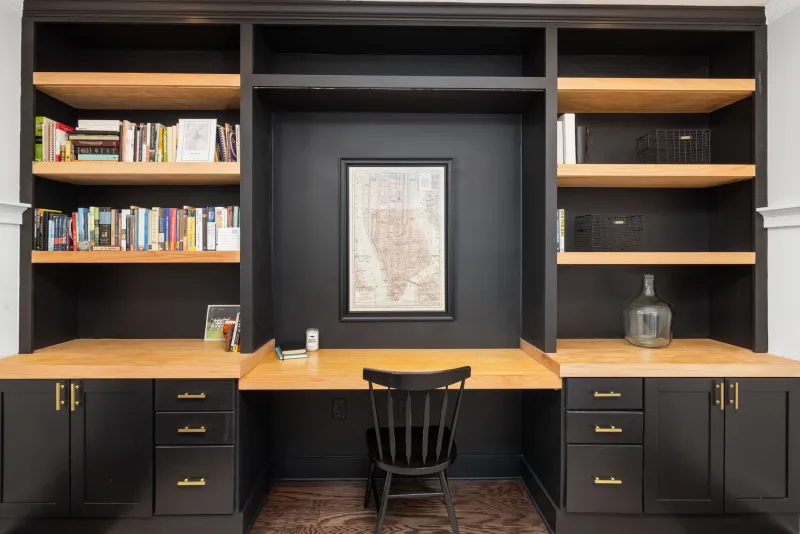
Architects and kitchen-and-bath designers, already accustomed to treating utilitarian spaces with increasing seriousness, began responding. Built-in lockers with assigned compartments for each family member appeared in custom home designs. Bench seating with integrated storage below and hooks above became a recognizable spatial formula. The language of organization — cubbies, pull-out drawers, charging stations for devices — entered the mudroom's vocabulary.
This was still largely a functional argument. The mudroom was being taken seriously because it worked, not because it was beautiful.
When Utility Became Aesthetic
The shift from functional priority to genuine design statement accelerated considerably in the first two decades of the twenty-first century. Several influences converged to elevate the mudroom's aesthetic ambitions.
The sustained popularity of farmhouse and transitional design aesthetics — amplified enormously by home renovation television and the visual culture of platforms such as Pinterest and Instagram — introduced a vocabulary of shiplap, painted cabinetry, and natural materials that translated naturally into mudroom design. A space that had previously been treated with whatever materials were cheapest suddenly became an opportunity to extend a home's design narrative from its first threshold.
Simultaneously, the growing cultural investment in sustainability and conscious consumption gave the mudroom new symbolic weight. A well-organized transitional space, the argument went, supported more intentional living: a place to hang reusable bags, store gardening tools, remove shoes in accordance with increasingly mainstream practices borrowed from Asian domestic customs, and manage the flow of items entering and leaving the home. The mudroom became, in this reading, not merely a practical buffer but a spatial expression of values.
The COVID-19 pandemic of 2020 accelerated this trajectory with unusual force. As the boundary between domestic life and the outside world became charged with new anxieties, the transitional space between exterior and interior acquired heightened psychological significance. Homeowners and designers alike reconsidered the entry sequence with fresh urgency. The mudroom — or its absence — suddenly felt consequential in ways it never had before. Renovation inquiries for dedicated entry spaces rose sharply during this period, a pattern documented by multiple industry surveys and design publications.
Material Ambitions
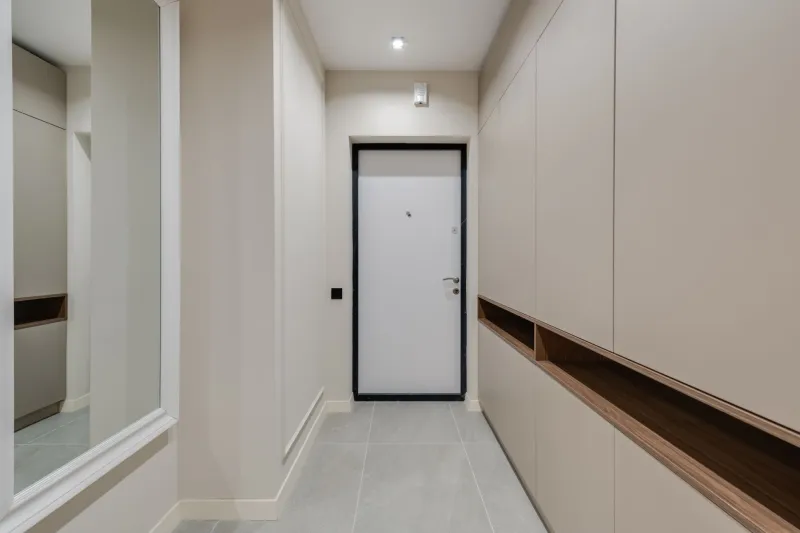
The contemporary mudroom, as it appears in the portfolio work of American architects and interior designers today, is a room of considerable material sophistication. Tile selections that would not be out of place in a primary bathroom now appear on mudroom floors. Cabinetry finishes coordinate deliberately with adjacent kitchen millwork. Quartzite or honed marble countertop surfaces — once unimaginable in a space defined by mud and moisture — have made appearances in high-end residential projects.
Natural materials, in particular, have become a dominant thread in mudroom design. White oak, blackened steel, unlacquered brass, and hand-thrown ceramic hooks speak to a broader domestic aesthetic that prizes authenticity and material honesty. The mudroom, positioned at the literal threshold between the natural world and the cultivated interior, has become a logical home for these material gestures.
Lighting, long ignored in transitional spaces, has also received renewed attention. Pendant fixtures, sconces, and layered lighting plans now appear in mudrooms that previously made do with a single overhead fixture. The implication is clear: this is a room designed to be experienced, not merely endured.
A Room That Tells the Truth
What makes the mudroom's transformation genuinely interesting, from the perspective of design history, is what it reveals about the American interior's evolving relationship with authenticity. For much of the twentieth century, the domestic ideal was one of seamless presentation — a home that concealed its functional machinery behind polished surfaces. The mudroom, as a space defined entirely by function, had no place in that ideal.
The contemporary interior, by contrast, increasingly values the visible acknowledgment of how life is actually lived. Open shelving, exposed materials, and the celebration of daily ritual over formal performance have all contributed to a domestic aesthetic that is less interested in concealment and more interested in honesty. The mudroom, in this context, is not a compromise but a feature — a room that tells the truth about how a household operates, and does so with growing confidence and considered design.
That a space once defined by its invisibility has become a room worth designing, photographing, and studying is, in its own way, a significant chapter in the history of American interiors. The mudroom did not rise by accident. It rose because the culture around it changed — and the rooms we choose to make beautiful are always, in the end, a record of what we have decided to value.