From Function to Ritual: The American Fireplace and Its Long Road Back to Meaning
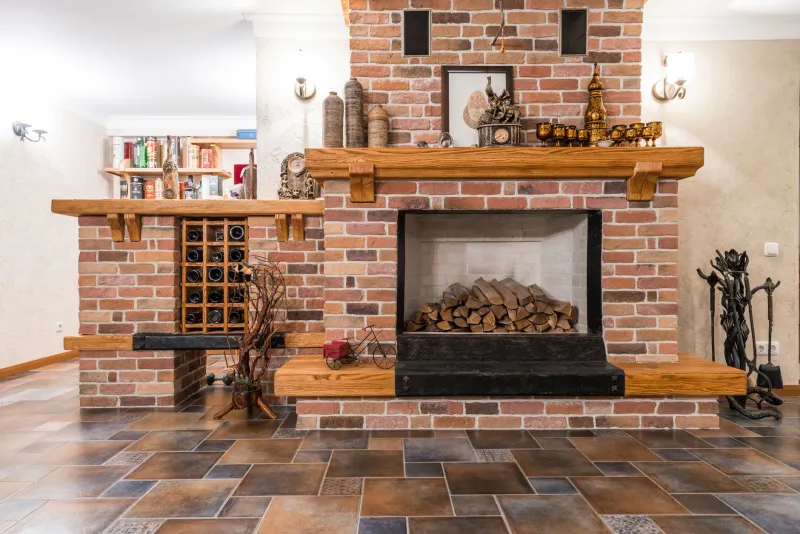
There is a particular kind of absence that announces itself through presence. The fireplace that sits cold and decorative in the center of a living room wall is not invisible—it is, in fact, quite impossible to ignore. Yet for much of the late twentieth century, Americans learned to look past it, treating it as inherited furniture rather than architectural intention. The hearth, which had organized domestic life for centuries, became something closer to a period prop: retained for resale value, acknowledged at Christmas, otherwise forgotten.
That story is now reversing. Across American interiors—from urban lofts in Chicago to sprawling farmhouses in the Hudson Valley—designers are repositioning the fireplace as a deliberate focal point, one chosen not for warmth but for weight. Understanding why requires tracing the object's long and surprisingly complicated cultural biography.
The Hearth as Architecture's First Principle
For most of American domestic history, the fireplace was not a design choice. It was a structural necessity. Colonial homes were organized around their hearths the way modern homes are organized around plumbing: everything else accommodated the central function. In the seventeenth and eighteenth centuries, a single large fireplace in the keeping room served simultaneously as the source of heat, the site of cooking, and the gathering place for family life. The word "hearth" carried moral weight as well as physical warmth—it appeared in the language of home, nation, and belonging with a frequency that reveals how thoroughly it had been absorbed into the culture's self-understanding.
As American homes grew larger and more specialized through the nineteenth century, the fireplace multiplied. Parlors, bedrooms, and libraries each acquired their own, and the mantelpiece became one of the primary surfaces upon which domestic identity was displayed. Clocks, mirrors, portraits, and decorative objects arranged above the firebox communicated social standing and aesthetic sensibility in equal measure. The fireplace was not merely functional; it was the room's organizing argument.
The Long Cooling
Central heating changed everything. The introduction of coal furnaces in the mid-nineteenth century, followed by oil and gas systems in the twentieth, quietly dismantled the fireplace's practical authority. By the postwar era, when American suburbs expanded rapidly and homes were built for efficiency rather than ceremony, the fireplace had become optional. Many tract homes omitted it entirely. Those that included it did so as a selling feature—a gesture toward tradition rather than a structural commitment.
The shift was not only technological. The open floor plans that came to define mid-century and late-century American interiors posed a spatial problem for the traditional hearth. A fireplace requires a wall, and the walls were disappearing. Television, which arrived in living rooms in the late 1940s and early 1950s, completed the displacement. The screen assumed the hearth's former role as the room's focal point and gathering device. Furniture arrangements pivoted accordingly. The fireplace, now competing with a more compelling visual anchor, lost the argument.
By the 1980s and 1990s, many fireplaces had been sealed, converted to gas inserts of dubious aesthetic merit, or simply ignored. The decorative fireplace—operational in theory, untouched in practice—became a cliché of middle-class American interiors, present but purposeless.
What Was Lost Beyond the Heat
Designers working in contemporary American homes have begun articulating something that research in environmental psychology has been quietly documenting for years: the experience of watching fire is neurologically distinct from other forms of visual stimulation. Studies suggest that the flickering of flames produces measurable reductions in blood pressure and induces states associated with relaxation and social ease. The anthropologist Michael Dunbar has argued that fire-gazing may engage ancient neural pathways related to social bonding—that humans are, in some measurable sense, wired for the hearth.
Beyond the biological, there is the question of spatial grammar. A room without a focal point is a room without a hierarchy, and hierarchy—despite modernism's long argument against it—turns out to be something people crave in domestic space. The fireplace provided what the television also provides but less elegantly: a reason for the room to cohere. When it was removed or ignored, designers found themselves searching for substitutes. Oversized artwork, statement furniture, and architectural niches all attempted to fill the organizing role the hearth had once played without effort.
The Contemporary Resurrection
The fireplace's return is not a single movement but a convergence of several. At the luxury end of the market, statement fireplaces—often custom-designed, occasionally sculptural, sometimes deliberately theatrical—have become the defining feature of high-end residential projects. Designers including Kelly Wearstler and Studio McGee have incorporated fireplaces not as historical references but as contemporary gestures, treating them with the same intentionality applied to any major architectural element.
The materials have changed accordingly. Where the Victorian mantelpiece favored carved marble and ornate millwork, the contemporary statement fireplace is as likely to feature raw concrete, blackened steel, or hand-applied plaster. The form has been stripped and reinterpreted—sometimes to the point where the object barely resembles its ancestors—while the spatial logic remains intact. The fireplace still anchors the room. It still commands the wall. It still asks furniture to orient itself in response.
Gas and ethanol fireplaces have made installation possible in spaces where traditional wood-burning would be impractical, expanding the geography of the revival. Apartment dwellers in New York and San Francisco, long excluded from the fireplace conversation, are now incorporating ventless ethanol units into renovated spaces with notable enthusiasm. The absence of smoke does not appear to diminish the psychological effect.
An Object Chosen Rather Than Inherited
Perhaps the most significant shift in the fireplace's contemporary meaning is precisely the voluntariness of its presence. When a homeowner in 2024 installs or restores a fireplace, they do so without necessity. The heat is supplemental at best. The choice is therefore legible as a statement about values—about slowness, about ritual, about the kind of domestic life one wishes to inhabit.
This is, in a sense, the ultimate expression of what design history has always traced: the moment an object outlives its original function and acquires a new one, richer and more complex than what it replaced. The fireplace is no longer primarily about warmth. It is about the idea of warmth—about gathering, about presence, about the ancient human preference for a room that has a center.
In restoring the hearth to its former position, contemporary designers are not practicing nostalgia. They are recognizing that certain spatial principles endure because they correspond to something durable in human experience. The fire has changed. The need for it has not.