Behind Closed Doors: The Long Transformation of the American Bedroom into a Personal Sanctuary
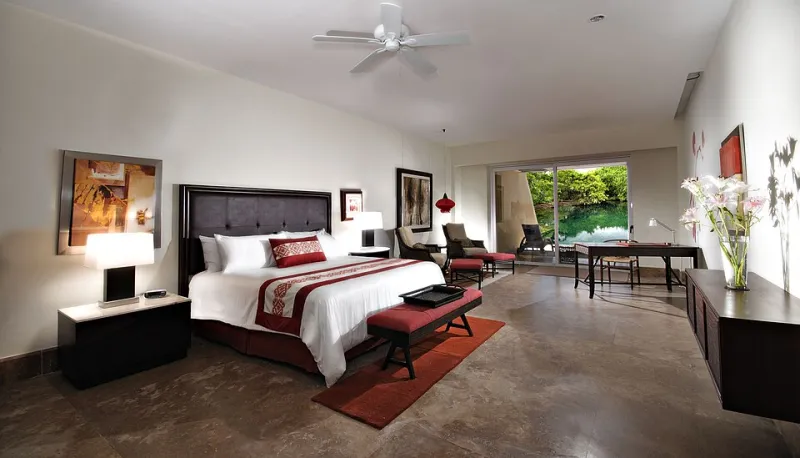
Photo: Grand Velas Riviera Maya, CC BY-SA 2.0, via Wikimedia Commons
There is perhaps no room in the American home that better documents the nation's shifting relationship with rest, identity, and private life than the bedroom. For much of the country's domestic history, the bedroom was a functional chamber — a place to sleep, to dress, and occasionally to recover from illness. It was not a destination. It was not an aspiration. Yet by the early twenty-first century, the master suite had become the most emotionally charged room in the house, a space that Americans were willing to finance, renovate, and redesign with a dedication once reserved for the parlor or the dining room. Understanding how this happened requires examining not just the history of interior design, but the social and economic forces that quietly reshaped what Americans believed they deserved at the end of a long day.
The Functional Origins of the American Sleeping Room
In colonial and early American homes, the bedroom — to the extent that such a distinct room existed at all — was rarely a private space. Families shared sleeping quarters out of necessity, and even in more prosperous households, beds were significant pieces of furniture precisely because they were expensive, not because the rooms that contained them were considered worthy of aesthetic investment. The great canopied beds of the seventeenth and eighteenth centuries were statements of wealth, but the rooms around them were often spare, cold, and utilitarian.
Through the nineteenth century, as the American middle class expanded and domestic architecture grew more compartmentalized, bedrooms began to acquire a degree of social meaning. The Victorian bedroom, particularly the master chamber of an upper-middle-class home, was furnished with care — a matching suite of walnut or mahogany pieces, a marble-topped washstand, perhaps a small upholstered chair near the window. Yet even here, the room existed primarily to serve the body's need for rest and hygiene. It was not conceived as a retreat from the pressures of the world outside.
The Mid-Century Bedroom and the Seeds of Change
The post-World War II housing boom introduced millions of American families to a new suburban ideal, and with it came a standardized bedroom typology that would define domestic life for a generation. The bedrooms of the 1950s and 1960s ranch house or split-level were modest by contemporary standards — functional rectangles furnished with twin or double beds, a dresser, and perhaps a small vanity. They were clean, cheerful, and entirely unambitious in their spatial claims.
Yet the cultural seeds of something larger were already being planted. The prosperity of the postwar decades gave Americans unprecedented discretionary income, and the consumer culture that flourished in this period began to reframe the home as a site of personal expression rather than mere shelter. Magazines such as Better Homes and Gardens and House Beautiful began publishing bedroom features that treated the room as a canvas for individual taste, introducing readers to coordinated bedding ensembles, decorative headboards, and the idea that a bedroom could possess something approaching a distinct aesthetic identity.
The Rise of the Master Suite
The decisive transformation came in the 1970s and accelerated sharply through the 1980s and 1990s. As American homes grew larger — the average new single-family home expanded from roughly 1,500 square feet in 1970 to more than 2,400 square feet by 2000 — developers and architects responded to consumer demand by enlarging and enriching the master bedroom. The term "master suite" entered the popular vocabulary, carrying with it a set of spatial and experiential promises that the old sleeping room had never made.
The suite typically incorporated three elements that had previously been separated or absent: a generous sleeping area, an attached private bathroom, and a dedicated sitting or dressing space. The private bathroom was perhaps the most significant addition, reflecting the broader elevation of the American bathroom documented elsewhere in design history. But the sitting area deserves particular attention. By incorporating a small sofa, a pair of armchairs, or a window seat into the bedroom, designers were making an architectural declaration: this room is not only for sleeping. It is for reading, for conversation, for quiet contemplation. It is, in the fullest sense, a room for living.
Prosperity, Burnout, and the Staycation Mentality
The cultural logic behind the master suite's ascendance cannot be separated from the changing conditions of American professional life. The late twentieth and early twenty-first centuries brought with them an intensification of work culture — longer hours, the erosion of boundaries between professional and personal time, and an ambient sense of overstimulation that technology both created and compounded. Against this backdrop, the bedroom assumed a new psychological function: it became the one room in the house that the outside world was not permitted to enter.
This retreat mentality crystallized in the concept of the "staycation," a term that entered American usage in the mid-2000s and reflected both economic constraint and a genuine philosophical shift in how Americans thought about rest. If the vacation home or the resort hotel had once represented the ideal of luxurious escape, the staycation redirected that desire inward, toward the domestic sphere itself. The master suite, reimagined with spa-like bathrooms featuring soaking tubs and rainfall showers, with gas fireplaces and blackout draperies and carefully curated bedding, became the vehicle through which this aspiration found physical form.
Design Language and the Vocabulary of Sanctuary
The aesthetic vocabulary that emerged to serve the sanctuary bedroom is itself historically revealing. Designers and homeowners gravitated toward materials and tones associated with calm: natural linens, muted palettes drawn from stone and water, organic textures in wood and woven fiber. The hotel aesthetic — particularly the language of the high-end boutique hotel — became enormously influential, as Americans sought to replicate in their private bedrooms the quality of retreat that had previously required travel to obtain.
Fireplaces returned to the bedroom with particular frequency, not for warmth in any practical sense but for the psychological associations that an open flame carries: intimacy, slowness, the deliberate suspension of productivity. The incorporation of smart technology — automated lighting, temperature control, motorized window treatments — further transformed the bedroom into a calibrated sensory environment, a room that could be adjusted to the precise conditions most conducive to rest and recovery.
What the Bedroom Reveals
The master suite's evolution from sleeping room to private sanctuary is, at its core, a story about what Americans have come to believe they require in order to sustain themselves. It reflects an acknowledgment, however quietly expressed in architecture and furnishings, that modern life is demanding in ways that earlier generations did not fully anticipate, and that the home must respond by providing spaces of genuine restorative power.
For the design historian, the bedroom's transformation is as instructive as any shift in American domestic life. It documents the interplay of economic aspiration, cultural anxiety, and the enduring human desire for a room that belongs entirely to oneself — a place where the world's claims are, at least temporarily, suspended. In that sense, the bedroom has not merely been renovated. It has been reconceived, and in that reconception, it tells us something essential about the private interior life of a nation.